MWA Scanning technology
All MWA scanners are based on the patented Laser Registration technology. A laser spot reads the film perforation and detects the edges of each hole. When the related film frame passes the gate, the LED flash is triggered exactly at that location.
In this way the scanner works independent of film shrinkage or misaligned splices. All frames across a stretched splice will be captured at their correct locations.
A plausibility check discards those holes that could not be clearly detected, for example if the hole is ripped off or covered with splicer tape. The related flash locations will be interpolated between neighbouring good holes in a range of 62 mm. If more holes in a row are not readable, the scanner will continue to scan with the last known frame distance (extrapolation) until good holes appear again.
Each film frame is stored as exactly one frame in the output file. The scanning speed is completely independent of the playback speed of the output file. The scanning speed ranges from 1 fps to 60 fps. The playback speed (for example 16, 18, 24 or 25 fps) is written in the output file’s header data, so a video player or editing program will play the file at it’s correct speed.
Since the scanner registers the perforation with a laser, it does not need the holes being visible in the picture. Therefore the entire 13,4K sensor area can be zoomed into the 35mm image, no resolution is wasted for the holes.
Optical System
The optical system is made of these components:
1) A cold LED lightsource with red, green and blue LEDs. The wavelength of the LEDs are optimised to match the film dye densities. Best colour channel separation is achieved already by the spectrum of the light. The red, green and blue light intensities can be set freely with a colour wheel in the software. The film base density and orange mask will be compensated optically in this way.
2) A light integration chamber and diffuser disk, which provide perfectly homogenous and diffused light for the suppression of scratches on the film surface.
3) A diffraction limited prime lens with aperture 5.6. The aperture can be user-adjusted to trade off depth of field and light throughput.
4) The Sony IMX661 imaging sensor. This sensor has an effective resolution of 13376 x 9472 pixels (127 MPixel) and features a colour filter array. Full size readout works up to 12 fps at 14 bits. 8K / half height readout is possible up to 25 fps at 14 Bits digitisation. By downscaling to a reasonable storage format of 6K one more bit is gained.
5) The lens and sensor assembly are motor-driven, thus allow for free zoom and focus alignment. The positions can be stored as presets. It is possible to zoom the 13,4K completely into a 35mm picture as well as to fit 35mm from edge to edge on the sensor area. The maximum zoom at 16mm allows for 8K within the picture.
Image Processing
The raw image data is transferred from the sensor to the workstation PC via CoaXPress-2 interface at 50 GBit/s and then passed through to the Nvidia graphics card. The entire image processing pipeline runs on the GPU and is 16 bits wide. At the output side various codecs are provided to pack the finalised images into files. The processing pipeline includes:
1) FPN (fixed pattern noise) correction. Compensates vignetting of the lens and shading in the dark.
2) HQ demosaicing algorithm. Decodes the color filter array into separate color channels.
3) Gamma LUT. This includes the setting of a gamma correction via color wheel, user drawn gamma curves and inversion of negative films.
4) Color space conversion matrix for Rec.709 or Rec.2020 output.
5) MTF (modulation transfer function) correction. This ensures a flat spatial frequency response and may also be utilised to soften or sharpen the picture if desired.
6) Generation of images for live preview and separate reference monitors. Generation of waveform, vectorscope and focus assist displays.
7) Cropping and scaling to the desired output resolution.
8) Picture stabilisation (optical pin register) with reference to the perforation hole.
9) Output file writing, available encoders are:
It is possible to store an H.264 proxy video parallel to scanning in other formats.
It is possible to save sensor RAW data into a file, currently in PGM format.
The sound will either be embedded or stored as separate Broadcast WAV file.
Film transport system
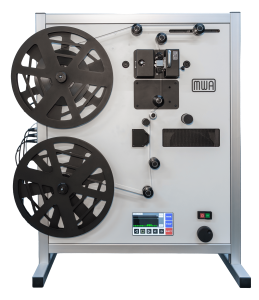
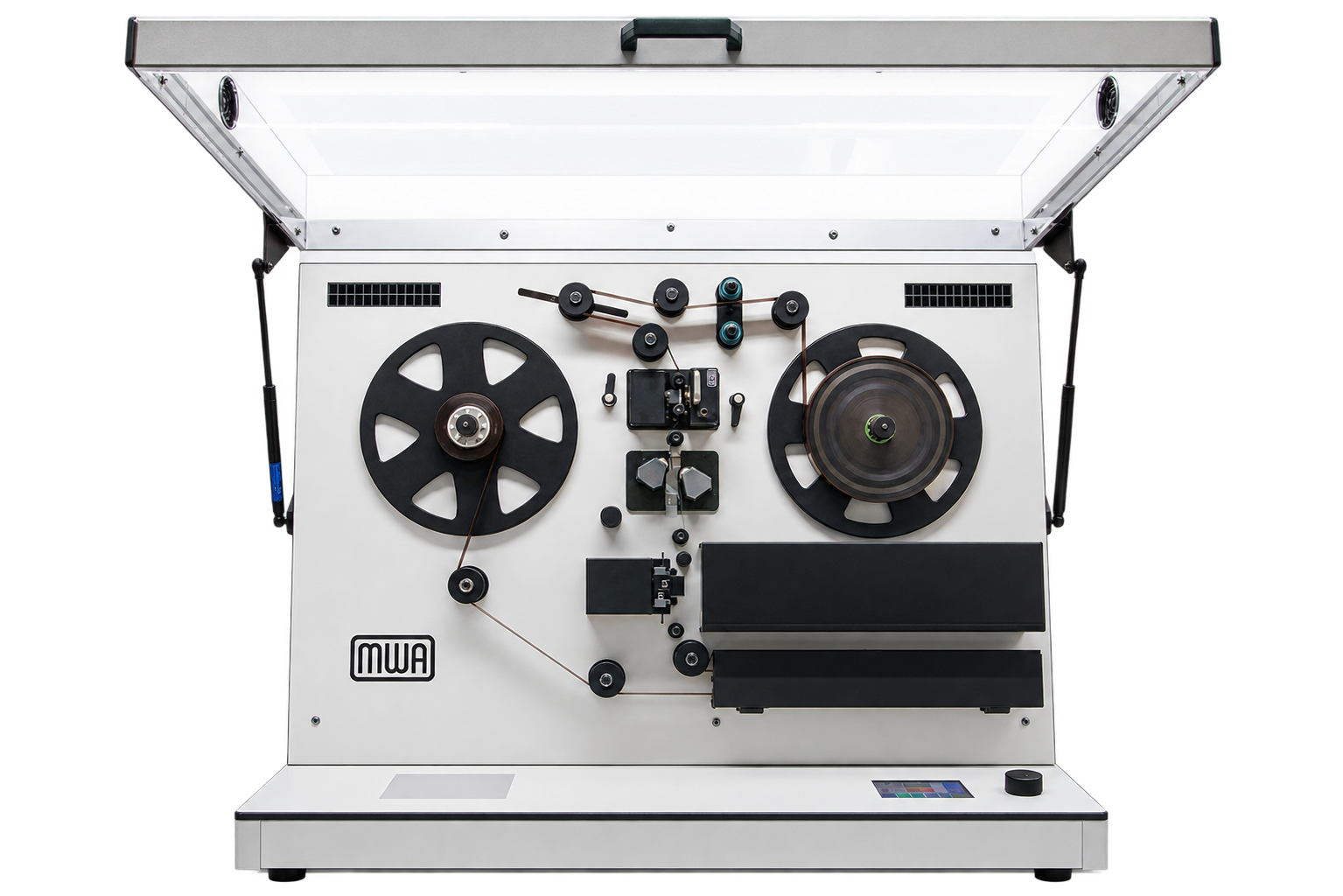
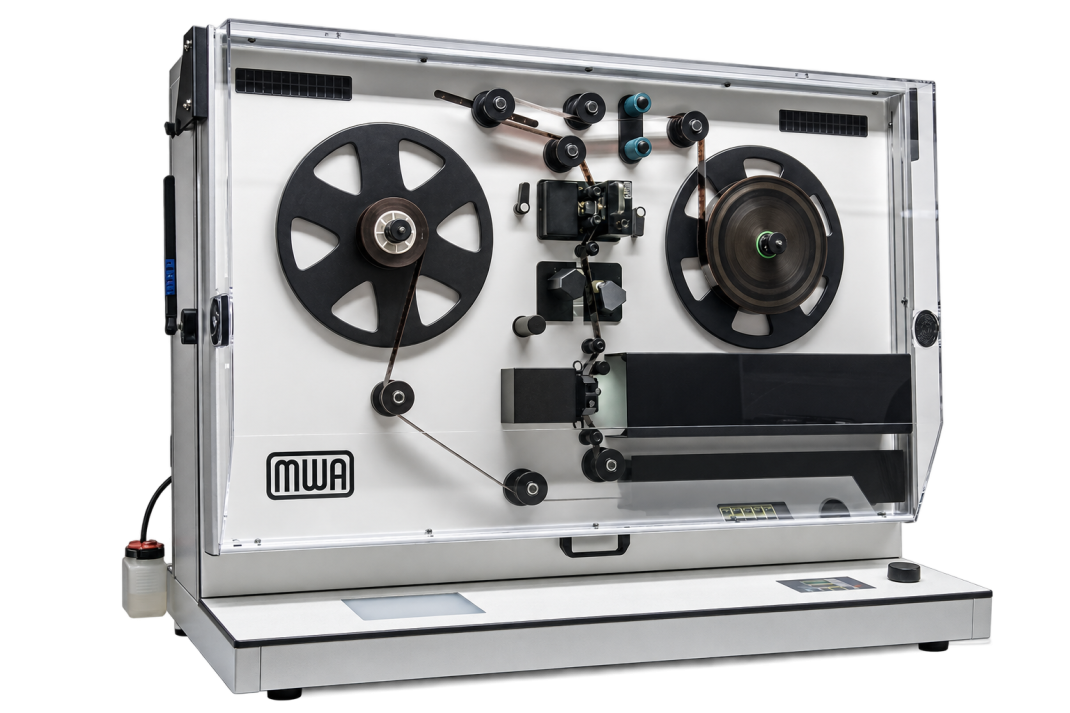
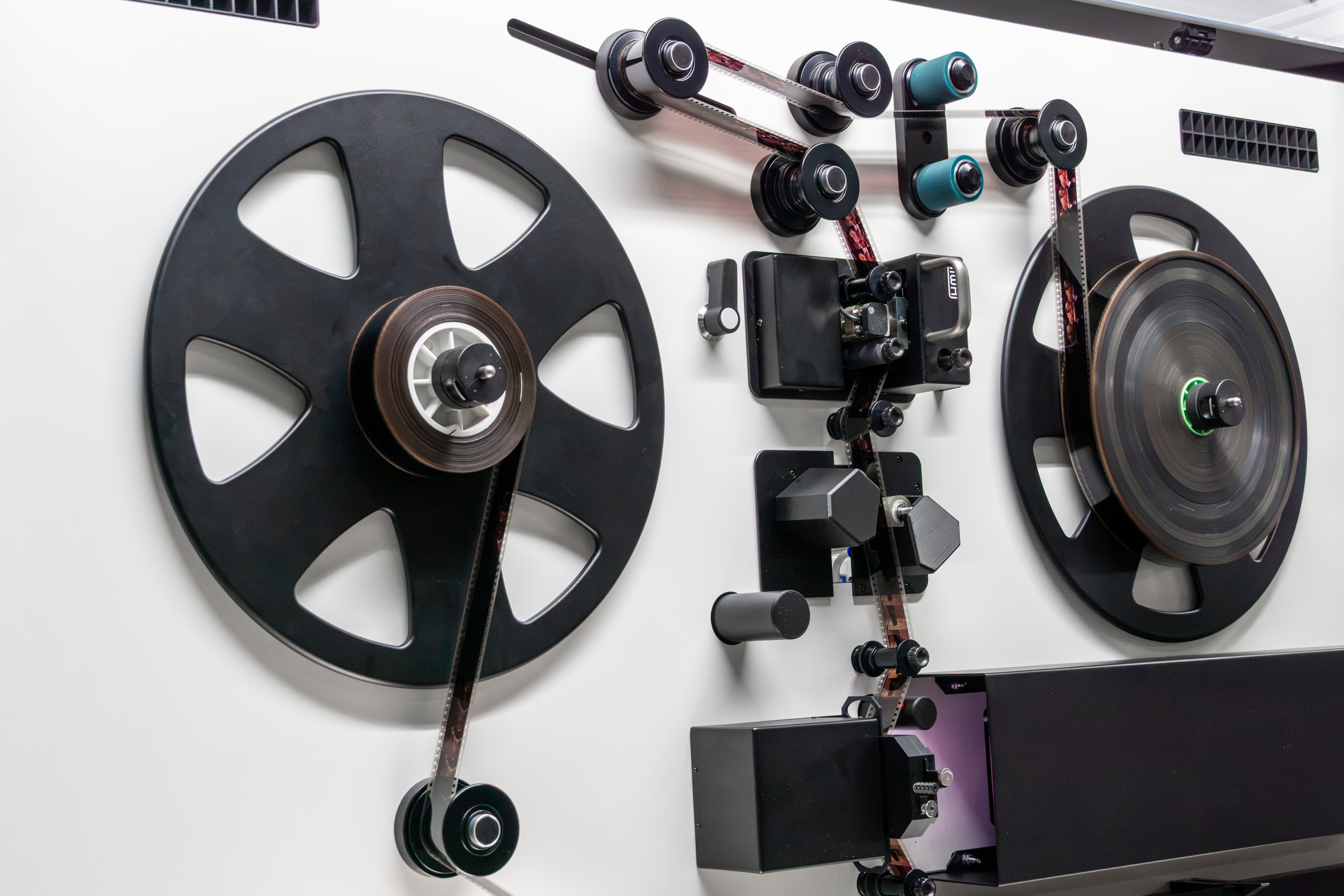
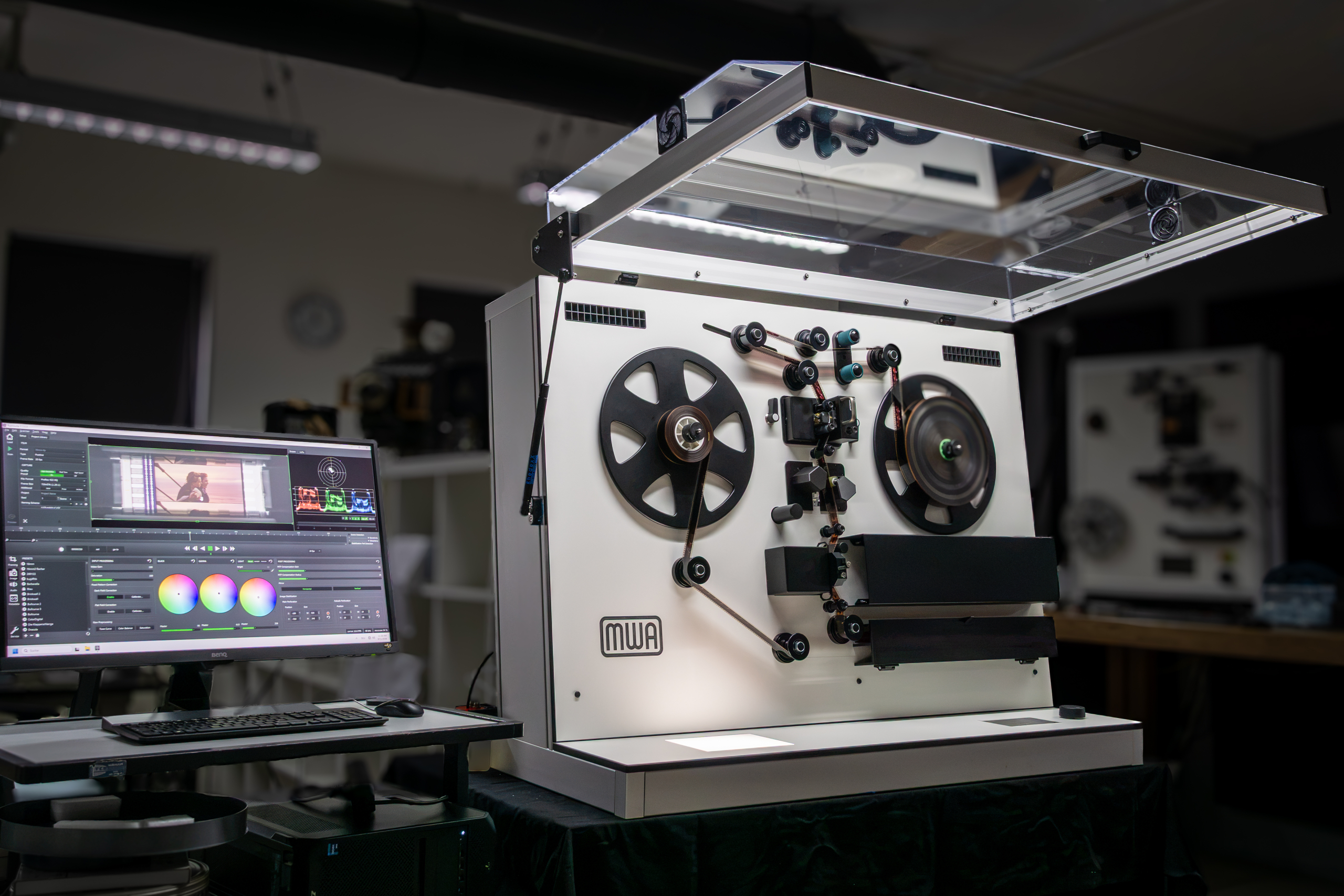
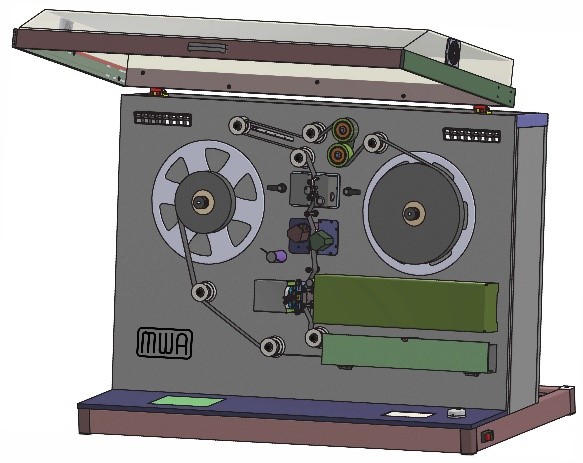
The film transport is conceived as sprocketless and capstanless system. The capstanless system invented by MWA is unique in the industry and provides these advantages:
1) Since there is no capstan which would require grip to the film, the minimum film tension can be set extremely low. The scanner runs with stable picture down to 0,2 Newton (20 grams), which is the lowest tension industry-wide. Very delicate splices and films with cracks can be run. However, the user can set the tension up to 6 Newton (600 grams).
2) Having no capstan means there is only one film loop going from reel to reel. Therefore only one tension roller is needed. That greatly simplifies the film path. Fewer components mean fewer sources of error and fewer stress to the film, so the user benefits from a robust and easy to handle transport platform.
The following features were specifically designed to handle old films:
1) Stop at sticky reel: The transport detects adhesion between film layers (for example sticky splices) and stops quickly without loosing the timecode. The user can peel off the layer and continue to scan.
2) Filmgate, wetgate and sound heads automatically withdraw when going to shuttle speed.
3) Definable global limits for speed and acceleration prevent the user from running too fast.
4) Overall large rollers avoid sharp bending of the film.
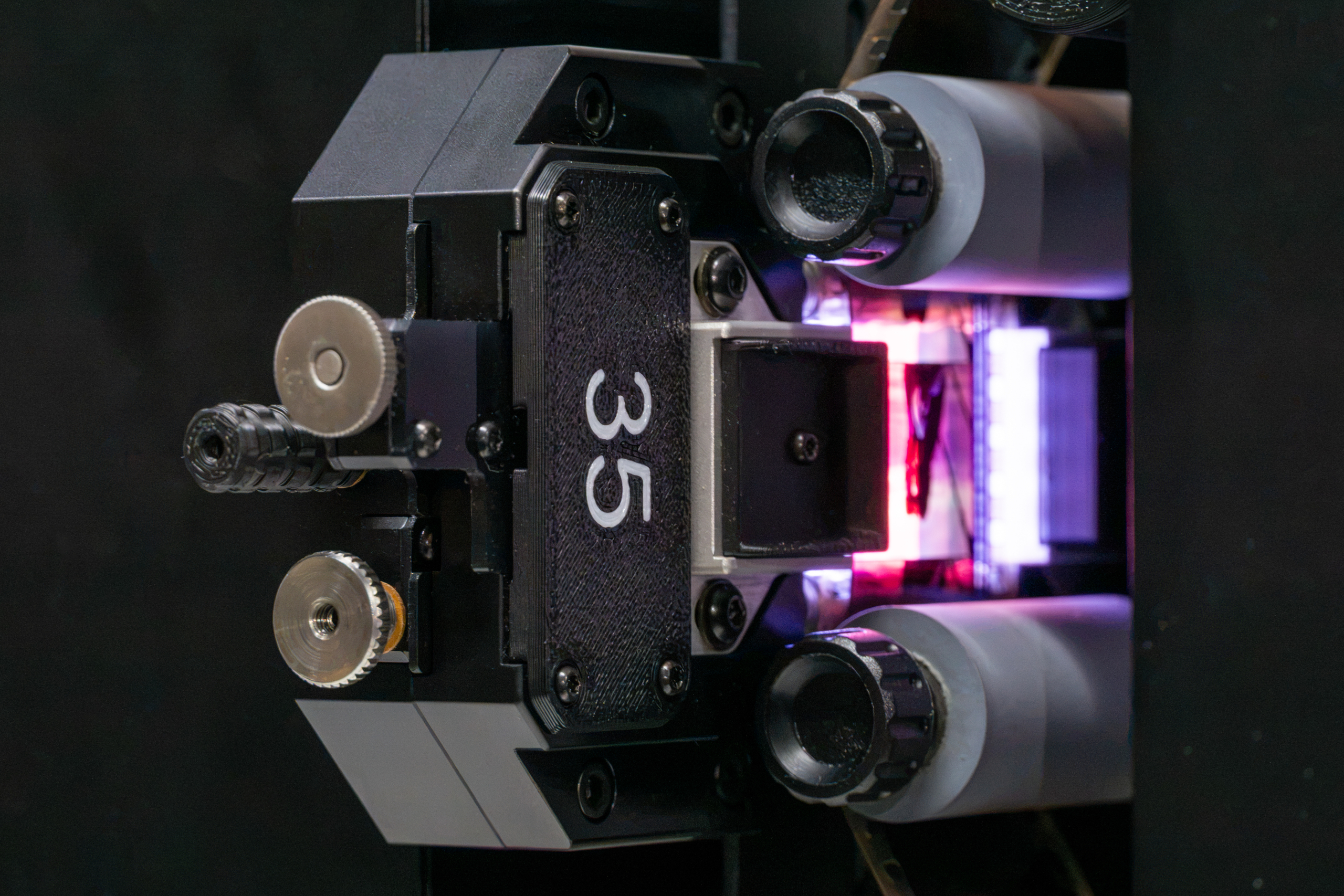
5) The film gates are designed with ball bearings instead of slide rails. The film will be kept flat and evenly focused without friction on the surface.
Easy Wet Gate
The purpose of a wetgate is to suppress the visibility of scratches on the film surface by filling them out with a liquid that has a similar refraction index as the base material. In a traditional immersion wet gate, the film passes through a basin containing perchloroethylene, which is a carcinogenic and environmentally harmful substance.
MWA’s Easy Wet Gate instead utilizes unproblematic isopropyl alcohol which is applied as a thin layer on the film surface by a pair of rubber rollers. Behind the film gate the film runs through a warm air dryer, where the liquid evaporates. In this way – depending on format and settings – up to realtime scanning speed is possible, 35mm runs at min. 12 fps.
The refraction index of isopropyl alcohol is smaller than perchloroethylene but still effective to narrow down the light scattering at scratches. Together with the fully diffused light of the LED source it greatly reduces the restauration effort in postpro.
The wetgate, pump and dryer are fully automated, they attach to the film only when playing forward. A plexiglass hood traps any vapor and smell and tubings are provided for connection to an exhaust system.
Audio System
The machine features a socket for exchangeable sound modules for all types of sound formats. There are modules for single formats as well as combined modules for 16+35 mm optical tracks and magnetic heads.
For the optical sound we provide dedicated sound heads, we do not extract the sound from the image. Therefore we achieve an uncompromised sound quality and can use the entire sensor resolution for the image (no wasting of pixels for the sound track).
The analog-to-digital conversion is located directly inside the sound heads for the best possible noise immunity. The magnetic heads are fully shielded against interference. The preamplifiers and ADCs reach a dynamic range of 110dB, so they exceed the limit of physics of the analog medium by far.
The entire audio processing including tape equalisation and picture to sound delay matching is carried out digitally.
A key feature of the audio processing is the Velocity-Adaptive Sampling Technology (VAST) invented by MWA in 2015. This compensates jitter by measuring the tape speed with an encoder roller close to the pickup head and resampling the sound accordingly. This method unlocks the following benefits:
1) The wow+flutter performance exceeds that of a traditional capstan drive. Typical DIN weighted values are 0,05% at 16mm and 0,03% at 35mm.
2) The wow+flutter becomes independent of the scanning speed. You can scan fragile material as slow as 5 fps without sacrificing the sound quality. Traditional capstan drives instead are unable to suppress jitter at low speed, they will only achieve their jitter specification at realtime speed!
3) It avoids the expensive capstan motor and thereby allows for a film tension as low as 0,2 Newton, as described before.
The scanner has a rear panel with manifold audio I/Os, such as analog and digital XLR and SPDIF. You can feed external sound from a Sepmag follower. Biphase in and out are provided for synchronisation. To synchronise two MWA machines there is also the more advanced MWA-422 control connection. Any combination of MWA machines is possible, for example a flashscan nova can serve as sound follower to a spinner S3.
Up to 8 sound channels are simply transferred to the flashsuite operational software through the USB connection that already exists for the machine control. External PC sound cards or similar are not needed.
The flashsuite software features per-channel equaliser and gain settings and an 8×8 mixing matrix. Any combination of film and external sounds can be routed and mixed into the output file.
Whenever the scanning speed deviates from the output file speed, the sound will be resampled automatically. For example you can scan at 5 fps and set the file playback speed to 24 fps. In this case the sound will be downsampled to match the length at 24 fps and “24 fps” will be written in the header of the file.
Software Features
The flashsuite operational software and the Windows workstation are integral parts of the scanning system and are always delivered in a bundle. The software features:
1) Transport controls (play, shuttle, single steps, record, endstops, goto timecode … )
2) Optical controls (zoom, focus, frameline, perf stepping)
3) Image format controls (mirroring, cropping, scaling, masking, anamorphotic correction)
4) Colour wheels (lightsource, gamma, black, curves, saturation, hue)
5) Video instruments (waveform, vectorscope, focus assist)
6) Live preview (preview screen, second screen, 100 % – 800 % pixel magnifier)
7) Scan automation (timeline, scene detection, edit list)
8) Audio controls (mixing matrix, gain, equaliser, monitoring mixer, VU meter)
9) DPX Metadata editor
A Tangent Devices Wave Panel can be connected to control most settings.
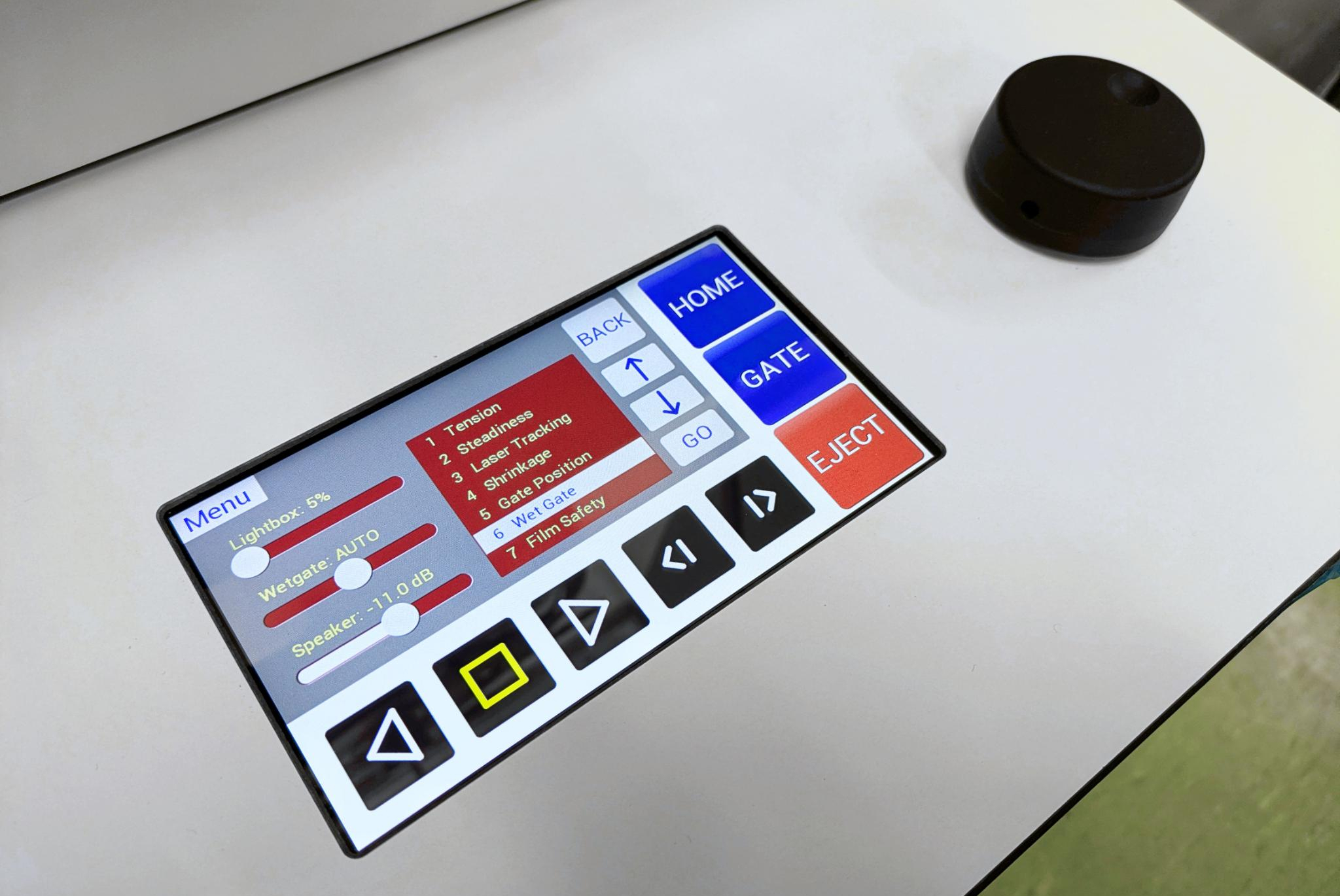
The scanner has a local touchscreen and a jog/shuttle knob that offer the most transport controls directly at the machine, even while the PC is shut down.
Summary of technical specifications:
Native resolution: 13392 x 9528 Pixels with Color Filter Array
Optical zoom: 16,5 mm … 55 mm film width
Sensor digitisation: 14 Bits, 12 Bits in turbo mode (60 fps)
Sensor dynamic range: 74,4 dB (standard mode), >90 dB (HDR double exposure / half speed mode, t.b.d.)
Output colour space: Rec. 709 and Rec. 2020, others on request
Output file formats: 8 / 10 / 12 / 16 Bit DPX, 8 / 16 Bit TIFF, ProRes, H.264, MotionJPG, FFV1, H.265 Intraframe, DNxHD, DNxHR, AVC-Intra 100
Lightsource: Cold LED flash array, red / green / blue with diffuser
Imaging sensor: Sony IMX661
Sensor scanning speeds:
1 – 12 fps (13376 x 9472, 14 Bit),
1 – 25 fps (8512 x 4736, 14 Bit),
1 – 60 fps (6688 x 2368, 12 Bit)
Minimum scanning speed with optical or magnetic sound: 5 fps
Film transport: Sprocketless and capstanless with Laser Registration
Stabilisation: Laser and edge guided, additional Optical Pin Register in software.
Film formats: 8, 16, 35 with standard rollers, 9,5, 17,5, 28 with optional Pathé rollers
Film types: B/W, Colour, Negative with / without orange mask
Film shrinkage: -4% … 5%. (Unlimited shrinkage via format definition)
Film tension: 0,2 … 6,0 N adjustable
Max. winding speed: 600 fps at 16mm, 300 fps at 35mm
Max acceleration: 100 fps / s
Power consumption (scanner only, playback): 100 W average + 400 W during acceleration + 400 W air dryer
Audio output: 48 kHz or 96 kHz, 24 Bit
Audio channels: 6 internal, 8 external
External audio Interfaces: 3x AES In/Out via XLR, 2x Analog In/Out via XLR, SPDIF In/Out via BNC, Wordclock In, Biphase In/Out, MWA-422
Audio head modules:
Optical S8
Optical 16
Optical 17,5
Optical 35 Stereo
Optical 16+35 combined
Magnetic 8+S8
Magnetic 9,5
Magnetic 16 COMMAG and 2-Track SEPMAG
Magnetic 17,5 SEPMAG
Magnetic 35 2 or 4 Track COMMAG and 3 / 4 / 6 Track SEPMAG